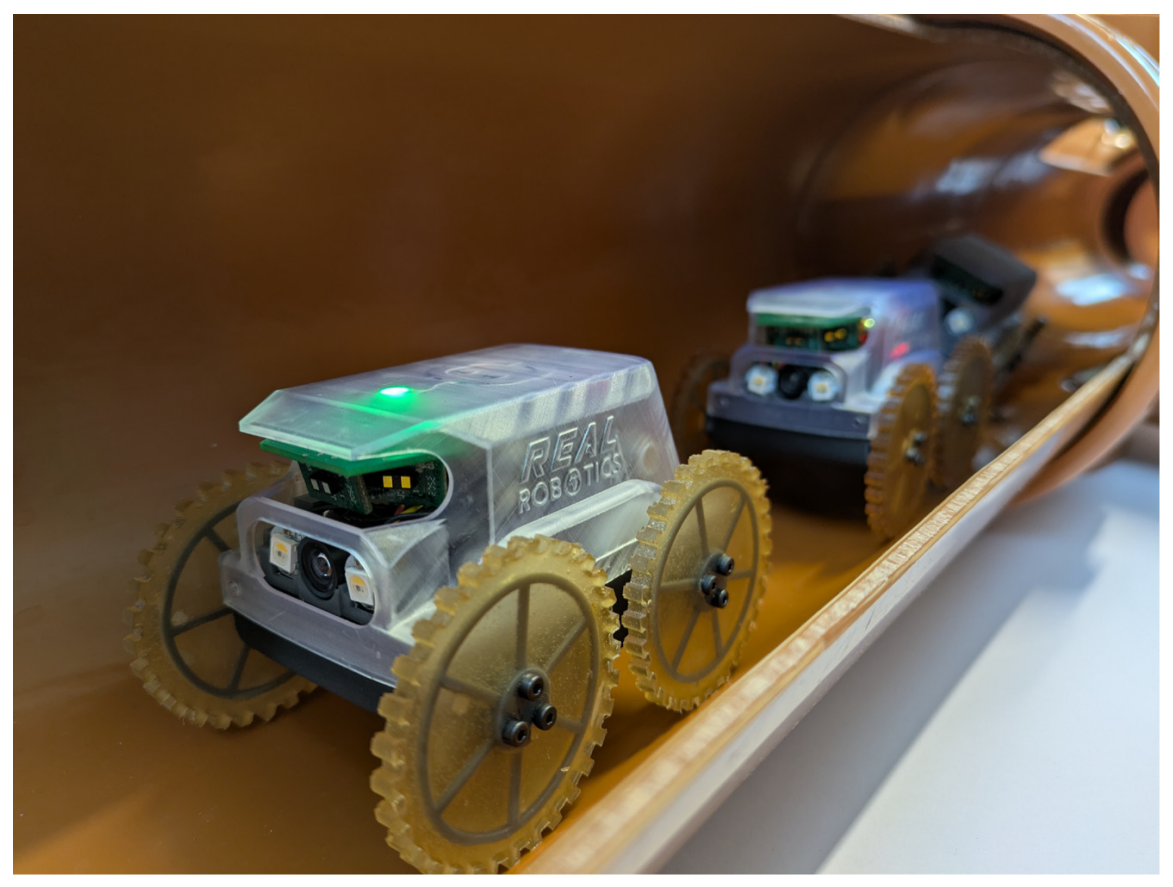
What if tiny robots could work together to explore the pipes beneath our cities? Our team explored this idea in a recent study using small autonomous robots, the “Mega-Joey” robots (shown above), designed to navigate confined pipe networks.
Inspecting underground infrastructure such as sewer pipes can be difficult, expensive and potentially dangerous. Traditional inspection robots are often tethered to cables and may require human operators, which can limit how easily they move through complex pipe networks. The researchers therefore investigated whether several small, wireless robots could work together to explore these environments more efficiently.
Mega-Joey is a compact wheeled robot measuring just over 10 centimetres in length. It is equipped with sensors that allow it to detect walls, obstacles and junctions within a pipe. Rather than relying on continuous human control, the robot can use this information to navigate its surroundings and make decisions about where to travel.
The most interesting part of the research is the way multiple Mega-Joeys cooperate. When a robot encounters a branch in the pipe, it communicates with the other robots to determine which sections have already been explored. The robots can therefore divide the exploration task between themselves instead of repeatedly investigating the same areas.
Our team tested the system using artificial pipe networks designed to represent underground infrastructure. They compared the performance of one robot with a team of three robots. The three-robot team was able to complete the exploration considerably faster than a single robot. It also used less energy per robot because the work was shared between the machines.
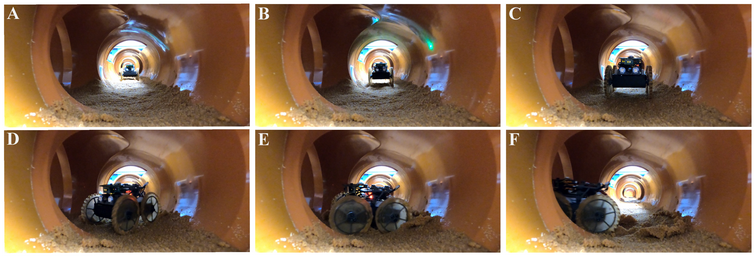
Frame captures from a video illustrating the performance of a robot in a pipe with heavy sediment deposits.
These results demonstrate an important idea in robotics: sometimes, a group of relatively simple robots can achieve more efficiently what would be difficult for one robot to accomplish alone. Working as a team can also provide redundancy, meaning that the failure of one robot does not necessarily bring the entire mission to an end.
However, the technology is still at an experimental stage. Real sewer systems are much more unpredictable than laboratory test networks, with factors such as water, debris, slippery surfaces and unreliable communication potentially creating new challenges. Future research will need to test the robots in larger and more realistic environments and improve their ability to recover from failures.
Nevertheless, the study provides an interesting glimpse into the future of infrastructure inspection. Instead of sending one large and complex machine underground, we could eventually deploy teams of small autonomous robots that explore, communicate and work together. Such robotic teams could make it possible to inspect places that are currently difficult or expensive for humans and conventional machines to reach.
Publication details:
Bhardwaj H, Shaukat N, Barber A, Blight A, Jackson-Mills G, Pickering A, Yang M, Mohd Sharif MA, Han L, Xin S, & Richardson R (2025). Autonomous, Collaborative, and Confined Infrastructure Assessment with Purpose-Built Mega-Joey Robots. Robotics, 14(6), 80. https://doi.org/10.3390/robotics14060080